

2010 buick lacrosse engine for sale Leave a comment
Small gasoline engines are everywhere: powering lawn mowers, portable generators, pressure washers, go-karts, small pumps, and countless do-it-yourself and light commercial tools. If you search for “small gasoline engines for sale”, you’ll find a confusing array of models, specifications, and terms — from “2-stroke” and “4-stroke” to “OHV” and “air-cooled.” This guide unpacks everything a buyer needs to know: how to compare engines, what specs matter, typical applications, maintenance tips, and how to avoid common mistakes.
This article is written to be SEO-friendly and practical: skim with headings, jump to the sections you need, or read straight through for a full primer.
At a glance: what you’ll learn
- Main engine types and how they differ (2-stroke vs 4-stroke, OHV vs side-valve)
- Key specs to read: displacement, horsepower, torque, RPM, bore/stroke, and fuel system
- Matching engine to application: mowers, generators, pumps, go-karts, mini-tractors
- Buying checklist and shopping tips for small gasoline engines for sale
- Maintenance schedule and troubleshooting common issues
- Emissions, safety, and storage best practices
- Pricing ranges and value traps (what to spend and where to save)
- SEO-friendly product page elements and image tips if you sell engines online
- FAQs and real-world buying scenarios
1 — What is a “small gasoline engine”?
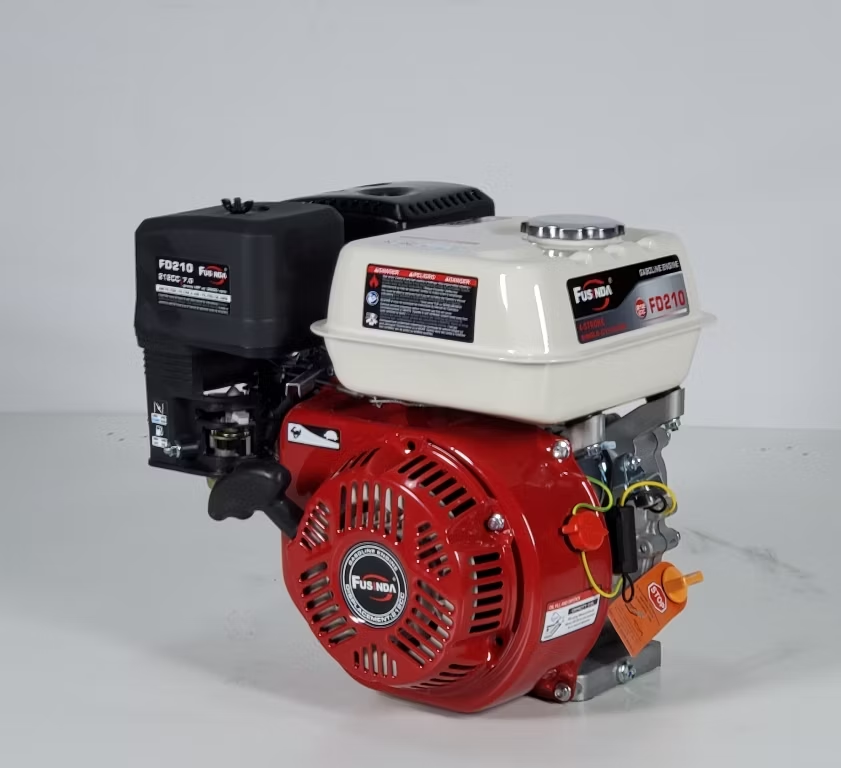
A small gasoline engine (also called a small petrol engine) is an internal combustion engine that runs on gasoline and is designed for portable and light equipment. These engines typically range from about 50cc to 1,000cc in displacement, with power outputs from a few tenths of a horsepower up to 25–30 HP for larger single-cylinder or small multi-cylinder units used on compact machinery.
Common applications:
- Push and ride-on lawn mowers
- Portable generators and welders
- Pressure washers and water pumps
- Tillers, mini-tillers, and cultivators
- Go-karts, minibikes, and small recreational vehicles
- Small utility vehicles and attachments for landscaping
2 — Key engine types and terminology (simple, actionable)
2.1 2-stroke vs 4-stroke
- 2-stroke: Simpler, lightweight, and high power density for displacement — commonly used in handheld tools (chainsaws, trimmers). Requires oil mixed with fuel or oil injection. Higher emissions and shorter lifespan compared to similar 4-stroke engines.
- 4-stroke: Most common for small engines used in mowers, generators, pumps. Has separate oil and fuel systems, quieter, more fuel efficient, cleaner exhaust, and longer running life.
2.2 OHV vs OHC vs side-valve
- OHV (Overhead Valve): Valves in the cylinder head, pushrods operating from the camshaft — widely used in modern small engines for durability and efficiency.
- OHC (Overhead Cam): Rare in tiny single-cylinder utility engines, more common in multi-cylinder or high-performance small engines.
- Side-valve (flathead): Older design, simpler and cheaper, but less efficient and less common today.
2.3 Air-cooled vs liquid-cooled
- Air-cooled: Most small engines. Lighter, simpler, and cheaper. Need good airflow; ideal for portable equipment.
- Liquid-cooled: Used in higher-power or high-duty applications where temperature control matters (some go-karts, racing, larger stationary engines).
2.4 Carburetor vs Fuel Injection
- Carburetor: Standard on many small engines; cheaper, easier to service, but tuned for specific conditions and altitude.
- Fuel Injection (EFI): Becoming more common; improves fuel efficiency, cold starts, altitude compensation, and emissions. More complex and pricier.
3 — Important specs explained (so you know what to compare)
Displacement (cc)
Engine size measured in cubic centimeters (cc). Larger displacement typically means more power and torque, but fuel consumption and weight increase too.
Horsepower (HP)
Power output. Small gasoline engines are often rated in HP or kW. Note whether the rating is gross or net — net is a more realistic usable number after accessories.
Torque (ft-lb or Nm)
Crucial for tasks requiring low-end grunt (mowers climbing hills, pumps under load). High torque at low RPM is often more useful than peak HP.
RPM / Operating speed
Rated and maximum RPMs tell you the engine’s best operating range and what it was designed for. Generators require specific RPMs to produce stable electricity (e.g., 3600 RPM for many small 60 Hz generators).
Bore and stroke
Affects torque vs speed characteristics: long stroke often yields more torque at low RPM; short stroke can favor higher revs.
Compression ratio
Higher ratio = more efficiency and power, but may require higher-octane fuel.
Starting system
- Recoil (pull) start — cheap, reliable for most small engines.
- Electric start — convenient, usually with battery; common on larger portable generators and ride-on equipment.
- Manual + electric combo — both present on many consumer units.
Ignition & governor
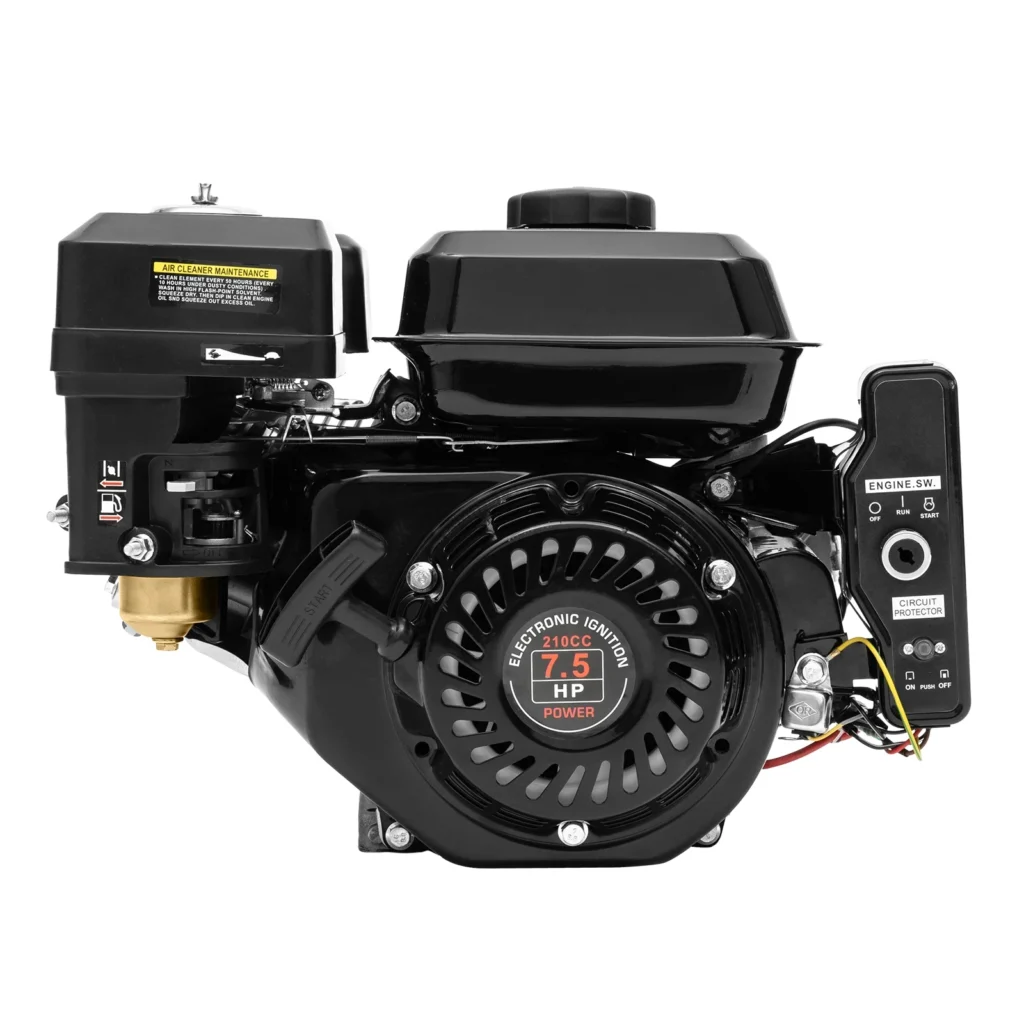
- CDI / Electronic ignition ensures reliable spark.
- Governor controls engine speed under load; important for steady generator output and consistent performance.
Weight and dimensions
Important for portability and mounting compatibility.
4 — How to match an engine to your project
Lawn mower / garden tractors
- Typical: 140–400cc (3–12 HP) 4-stroke OHV engines for push mowers; 300–800cc (8–25 HP) single- or twin-cylinder engines for ride-on tractors.
- Choose higher torque if you mow long grass or hilly areas.
Portable generator
- Match engine horsepower and rated RPM to the generator head. For example, many 120V/60 Hz small generators run at 3600 RPM.
- Consider a slightly higher surge rating for starting motors and compressors.
Pressure washer
- Pressure washers demand torque at moderate RPM. Choose 6–13 HP engines for consumer to professional models depending on pump size.
Water pump
- For trash pumps or centrifugal pumps, look for consistent torque and durability; 4-stroke OHV engines in the 4–10 HP range are common for portable pumps.
Go-karts & minibikes
- Small recreational builds often use 90–270cc 4-stroke engines; two-strokes in smaller cc ranges are used in performance applications but require more maintenance.
Commercial / rental use
- Prioritize overbuilt components, better cooling (liquid where appropriate), commercial duty oiling systems, and warranties.
5 — Buying checklist: how to evaluate small gasoline engines for sale
Use this checklist when browsing listings or visiting retailers:
- Application match: Does the engine’s torque curve and HP suit your equipment?
- Operating speed: Is the rated RPM compatible with the driven equipment (e.g., pump, generator)?
- Starting options: Electric start vs pull start — what do you need?
- Fuel system: Carburetor (easier, cheaper) or EFI (better performance/altitude)?
- Cooling type: Air vs liquid — check duty cycle and ambient use conditions.
- Mounting dimensions: Bolt pattern and physical dimensions — will it bolt onto your frame?
- Weight: Is portability important?
- Warranty & service network: Is there local support for parts and service?
- Emissions compliance: Does it meet local regulations (CARB, EPA, EU Stage)?
- Spare parts availability: Filters, carb rebuild kits, gaskets, recoil starters, etc.
- Price vs reputation: Don’t buy the cheapest unknown brand if you need reliability.
- Certifications & manuals: Availability of installation/service manuals is valuable.
6 — Where to buy (channels and pros/cons)
Local dealers & small engine shops
- Pros: Service, warranty support, test and fit, genuine parts.
- Cons: Sometimes slightly higher prices.
Big box stores (home improvement)
- Pros: Convenience, recognizable brands, sales.
- Cons: Limited model selection; parts/service can be inconsistent.
Online marketplaces (manufacturer sites, e-commerce)
- Pros: Wide selection, customer reviews, competitive prices.
- Cons: Verify shipping, returns, and warranty handling; mounting/fitment concerns.
Surplus & used engines
- Pros: Lower price.
- Cons: Riskier — always inspect compression, hours, oil condition, and ask for history.
Auction & salvage
- Good for project builds but requires mechanical knowledge and inspection.
7 — Pricing guide & value rules of thumb
Prices vary widely depending on brand, displacement, and features. Rough ranges (generalized):
- Small consumer 4-stroke (100–200cc): $120–$400
- Mid-range 4-stroke (200–400cc): $300–$900
- High-end single cylinder (400–800cc): $800–$1,800
- Commercial/twin cylinder (20–30 HP): $1,500–$4,000+
- Used engines: Prices depend on hours, model, and condition — expect 30–60% of new price for reasonable examples.
Value tips:
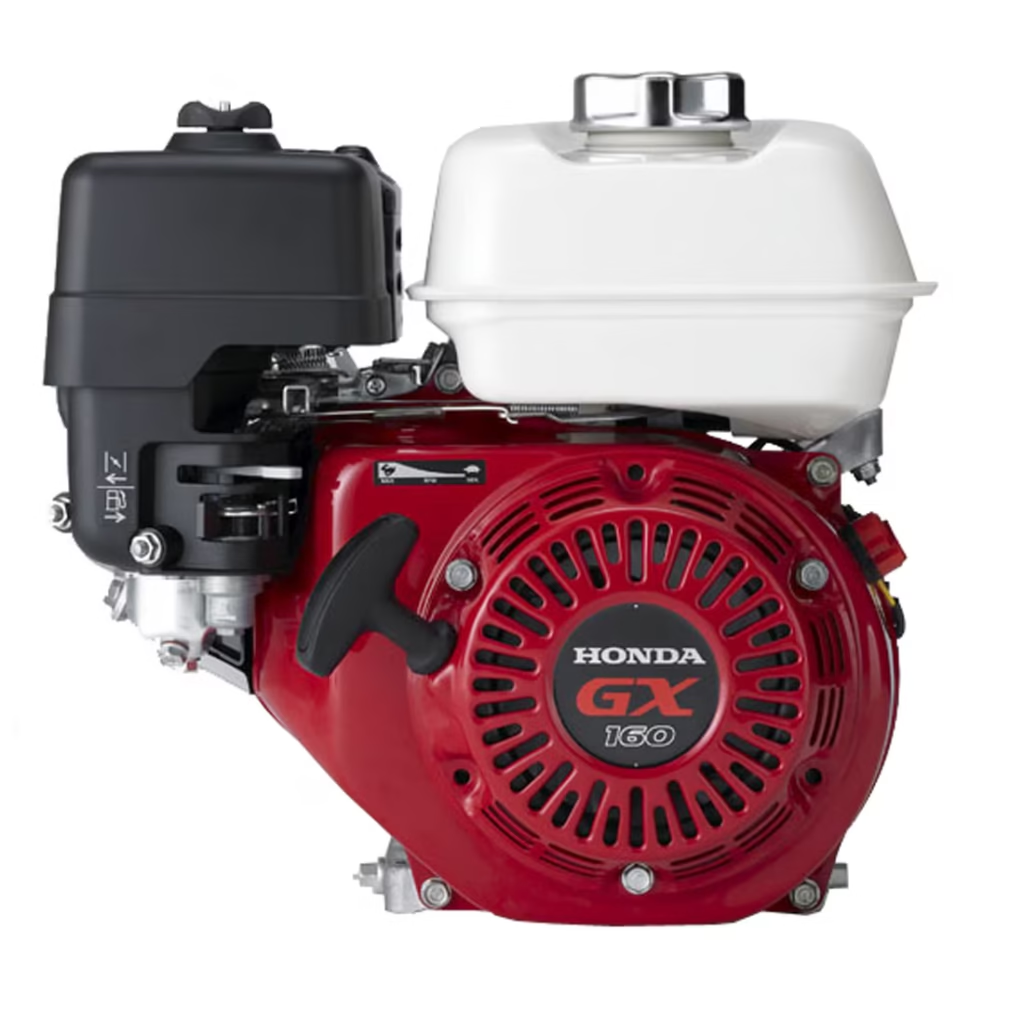
- Pay more for reputable OEMs and dealers if you need reliability and parts availability (Honda, Briggs & Stratton, Honda clone? — note that clones vary widely).
- For hobby projects where downtime is acceptable, a lower-cost engine may be fine.
- Consider lifecycle cost (fuel, maintenance, parts) not just purchase price.
8 — Maintenance: keep the engine running longer
A small gasoline engine is easy to maintain if you follow regular checks:
Daily / before each use
- Check oil level.
- Inspect air filter for large debris.
- Check fuel level and look for leaks.
- Ensure blades, drives, belts are secure (for mowers/pumps).
Every 25–50 hours
- Change engine oil for severe use (or follow manufacturer intervals).
- Clean/replace air filter paper element.
- Inspect and clean cooling fins.
Every 100 hours or annually
- Replace spark plug.
- Drain and clean fuel tank if necessary.
- Clean carburetor jets (especially if fuel is old).
- Check valve clearance on OHV engines if specified.
Storage (seasonal)
- Run the engine until fuel is low, or add fuel stabilizer and run 5–10 minutes.
- Change oil before storage for long periods.
- Remove battery or keep it on a tender for electric starts.
- Fog the engine if recommended for long storage.
Troubleshooting quick cheats
- Engine won’t start: check fuel, spark (remove plug, look for spark), compression, carburetor choke setting.
- Rough idle: dirty carburetor, air filter, or incorrect governor setting.
- Overheating: clogged cooling fins, low oil, or stuck throttle.
9 — Fuel, oils, and emissions
Fuel
- Use fresh gasoline with the correct octane; avoid ethanol blends if the engine isn’t rated for E10/E15 (ethanol can absorb water, damage carburetor gaskets).
- For 2-stroke engines, mix oil and fuel at the recommended ratio (usually 40:1 to 50:1 on modern 2-stroke engines).
Oil
- Use the manufacturer-specified oil grade (e.g., SAE 10W-30) and change intervals. For cold climates, choose winter-grade oil as advised.
Emissions & compliance
- Many engines sold in regulated markets must meet EPA, CARB, or EU Stage emission standards. If you operate in a regulated zone, ensure the engine is compliant — non-compliant engines may be illegal for certain uses.
10 — Safety tips
- Always operate in well-ventilated areas — carbon monoxide from gasoline engines is deadly.
- Keep hot parts away from combustible materials.
- Use protective gear: hearing protection (engines can be loud), eye protection when working with equipment.
- Secure the engine to reduce vibration and prevent movement.
- Follow manufacturer instructions for fuel handling and storage.
11 — Common pitfalls and how to avoid them
Buying wrong displacement or power
- Don’t buy a bigger engine thinking “more is better.” Oversized engines can consume excess fuel and may not match the driven equipment. Match torque and RPM.
Ignoring mounting and shaft specs
- Bolt pattern, shaft diameter, keyway, and rotation (CW/CCW) must match or adapt. Always verify these dimensions before purchase.
Overlooking local regulations
- Construction sites or commercial operations may require certified, low-emission engines or sound limits.
Buying cheap no-name engines with no parts
- You may save initially but pay later in downtime and unavailable spares. Prefer known brands or suppliers with parts catalogs.
12 — If you sell small gasoline engines: SEO & product page checklist
If your goal is to list small gasoline engines for sale online, here’s a product page framework that converts and ranks:
On-page SEO elements
- Title tag: Include main keyword + model + power rating.
Example: “4-Stroke OHV 196cc Small Gasoline Engine — 6.5 HP | Model ABC123” - Meta description: Value proposition + spec highlights + CTA (e.g., “Buy now — free shipping”).
- URL slug: short and keyword optimized:
/small-gasoline-engine-196cc-6-5hp - H1: Use a clear headline with main keyword.
- H2s and content: Provide spec table, use cases, compatibility, maintenance tips, and FAQs (structured content aids SEO).
- Schema/Product markup: Add price, availability, SKU, brand, and review ratings for rich results.
- Images: Multiple angles, mounting dimensions, spark plug, carburetor, start system; add alt text with keywords (e.g., “196cc small gasoline engine side view”).
- Videos: Quick start demo and maintenance video increase conversions.
- Reviews and user photos: Encourage buyers to upload photos of the engine in their equipment.
Conversion elements
- Clear pricing and shipping; warranty info; spare parts links; PDF manual download; live chat or phone support.
13 — Mounting, installation & integration tips
- Use vibration-isolating mounts for long life and operator comfort.
- Align shafts carefully; misalignment causes wear.
- Use recommended torque on mounting bolts.
- Check rotation direction before connecting driven equipment.
- If adapting to a different application, consider a bell housing or adapter plate and match shaft diameter and keyway.
14 — When to repair vs replace
Repair if:
- Engine has good compression, parts are available, and repair cost < 40–50% of replacement price.
- The engine is a known, well-supported model with documented parts.
Replace if:
- Compression is poor (ring/piston damage) and repair costs approach replacement.
- Critical parts are discontinued.
- The unit is heavily corroded, badly abused, or hours are extremely high.
15 — Popular use cases and recommended engine ranges (quick reference)
- Handheld outdoor tools: 25–65cc (2-stroke or 4-stroke compact)
- Push mower (residential): 140–190cc (3–8 HP) 4-stroke OHV
- Ride-on mower (residential): 300–700cc (8–25 HP) single or twin cylinder
- Portable generator (2–6 kW): 120–420cc (4–13 HP) depending on generator head efficiency
- Pressure washer (consumer): 5–8 HP (160–270cc)
- Trash pump / contractor pump: 6–13 HP (196–400cc) commercial models preferred
- Go-kart / minibike: 90–270cc depending on speed/weight goals
16 — Environmental considerations & newer tech trends
- Emission regulations are tightening in many regions; expect more EFI and catalytic exhaust in future small engines.
- Hybrid and electric alternatives are growing for some applications (lawn mowers, small generators). But gasoline engines still lead where energy density, continuous high power, and refueling speed matter.
- Battery start + smart controls: integration of battery-assisted electric start and engine control modules is increasing, improving cold starting and fuel metering.
17 — Checklist: Buying flow (step-by-step)
- List the application and required power/torque.
- Measure or note mounting and shaft dimensions of the gear you’ll drive.
- Choose engine type (4-stroke OHV recommended for general use).
- Compare specs (HP, torque, RPM, weight, fuel system).
- Verify emission compliance if required.
- Check warranty, parts availability, and local service network.
- Inspect or request compression test for used engines.
- Buy from reputable supplier and keep receipts, manuals, and parts lists.
18 — Top maintenance checklist (printable)
- Daily: Check oil, fuel, and visible damage.
- Every 25–50 hrs: Clean air filter, check bolts.
- Every 100 hrs or annually: Change oil, replace spark plug, inspect valves.
- Storage prep: Drain fuel or add stabilizer, store in dry place, fog engine if indicated.
19 — Troubleshooting common scenarios
Problem: Engine cranks but won’t start.
Checks: Fuel in tank? Fuel at carburetor? Spark at plug? Choke position? Flooded engine? Compression?
Problem: Engine starts then dies.
Checks: Fuel filter clogged, carb float stuck, vacuum leak, governor misadjusted.
Problem: Overheating.
Checks: Cooling fins blocked, oil low, heavy load, incorrect fuel/oil mixture (for 2-strokes).
Problem: Poor fuel economy or power loss.
Checks: Dirty air filter, old fuel, clogged jets, incorrect valve clearance, low compression.
20 — Frequently Asked Questions (FAQs)
Q: What’s the difference between a “small engine” and a “mini engine”?
A: The terms overlap. “Small engine” broadly refers to engines used in portable/light equipment (50–1000cc). “Mini” is sometimes used for the smallest range (under 200cc).
Q: Are Chinese/off-brand engines okay?
A: Many are fine for low-duty hobby projects, but quality, tolerances, and parts support vary. For commercial use, choose proven brands or suppliers with spare parts availability.
Q: How long should a small gasoline engine last?
A: With proper maintenance, many 4-stroke engines last thousands of hours. Consumer engines might be 1,000–3,000+ hours; commercial models are built for higher duty cycles.
Q: Can I convert a pull start to electric start?
A: Yes — conversion kits exist, but check space, flywheel compatibility, and electrical system needs (battery, starter motor). Often easier to buy a model with electric start.
Q: How do I store an engine for winter?
A: Drain or stabilize fuel, change oil, fog the cylinders (if recommended), remove battery or keep on tender, and store in a dry, covered area.
21 — Example buyer scenarios
Scenario A — Homeowner with a hilly lawn
- Needs: steady torque, ease of use, reliability.
- Recommendation: 200–400cc OHV 4-stroke engine, electric start optional, higher torque at low RPM.
Scenario B — Weekend mechanic building a go-kart
- Needs: compact, good power-to-weight, easy to adapt.
- Recommendation: 120–270cc 4-stroke with known aftermarket adapters and strong parts support.
Scenario C — Contractor with portable pumps
- Needs: heavy duty, reliable starts, commercial warranty.
- Recommendation: 6–13 HP commercial-rated engine, robust air filtration, easy access to service.
22 — Final buying tips & how to avoid regrets
- Test before you buy (if used): compression test, run under load, inspect oil and spark.
- Ask about parts: how quickly can you get filters, gaskets, carb kits?
- Keep the manual: installation diagrams and torque values saved for long term.
- Buy a little more torque than you think you need — it’s more useful than peak HP.
- Plan for maintenance: early oil changes and fresh fuel will improve longevity.
